Getting the appropriate message in front of the right people at the right time has always been the main goal of marketing, whether through traditional marketing vs digital marketing. But how brands do that has changed dramatically over the past two decades. Where a company once relied almost entirely on billboards, newspaper ads, and television commercials, it can now reach a global audience with a single Instagram post or a well-optimized landing page — a shift at the heart of traditional marketing vs digital marketing.
This shift has sparked an ongoing debate among business owners, marketers, and entrepreneurs comparing traditional marketing vs digital marketing: is traditional marketing dead, or does it still hold value alongside digital strategies? There is more to the reality of traditional marketing vs digital marketing than a straightforward either-or response. In this post, we’ll break down traditional marketing vs digital marketing — what separates the two, explore the strengths and weaknesses of each in the traditional marketing vs digital marketing debate, and help you figure out which approach, or combination of strategies, makes sense for your company when weighing traditional marketing vs digital marketing.
What Is Traditional Marketing?

Traditional marketing refers to the offline promotional methods that businesses have used for generations. It includes channels like:
- Print advertising — newspapers, magazines, brochures, flyers
- Broadcast media — television and radio commercials
- Outdoor advertising — billboards, transit ads, posters
Postcards, catalogs, and coupons delivered to physical addresses by direct mail - Telemarketing — cold calls and phone-based promotions
- Events and sponsorships — trade shows, community events, product launches
These methods dominated the marketing landscape for most of the 20th century, and many of them are still very much alive today. A well-placed billboard on a busy highway or a radio spot during a popular drive-time show can still generate significant brand awareness.
What Is Digital Marketing?

Digital marketing, on the other hand, encompasses all marketing efforts that use the internet or electronic devices. This includes:
Enhancing a website’s visibility on search engines through search engine optimization (SEO)
- Content marketing — blogs, videos, infographics, and other valuable content
- Social media marketing — organic posts and paid campaigns on platforms like Instagram, Facebook, LinkedIn, and TikTok
- Email marketing, including newsletters, advertising campaigns, and automated sequences
- Pay-per-click (PPC) advertising, such as social media and Google Ads
- Influencer marketing — partnerships with content creators
- Affiliate marketing — performance-based partnerships
Digital marketing exploded in popularity as internet usage grew, and it has become the primary channel for businesses of nearly every size, from local shops to multinational corporations.
Key Differences Between Traditional Marketing vs Digital Marketing

- Reach and Targeting
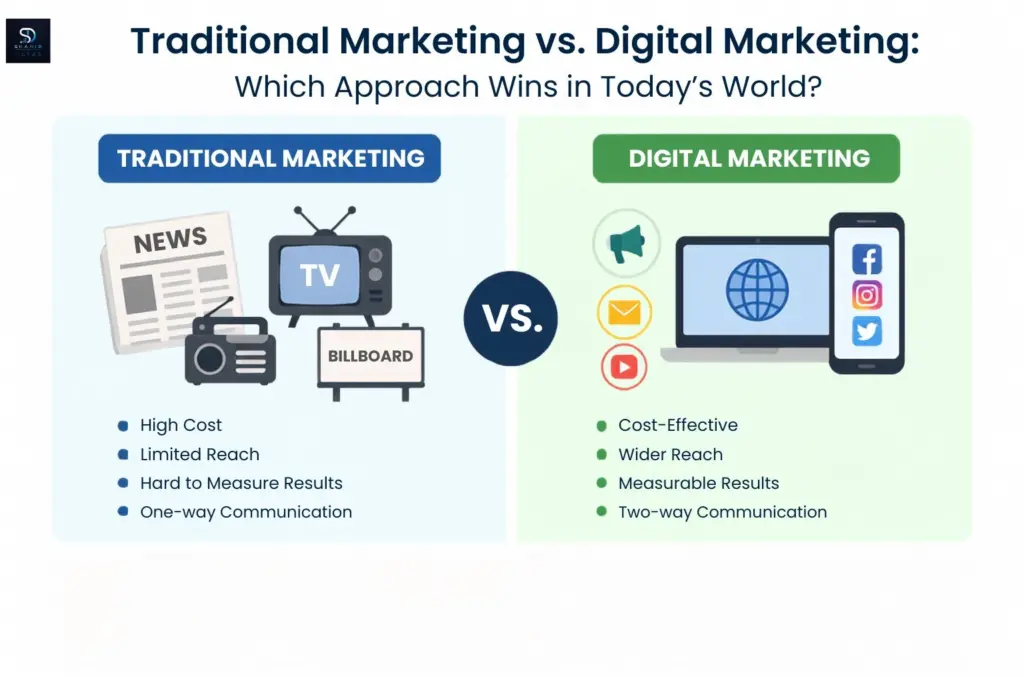
Conventional marketing typically has a broad reach. A TV commercial airs to everyone watching that channel at that time, regardless of whether they’re interested in the product. This broad reach can build brand awareness quickly, but it comes with significant waste — you’re paying to reach people who will never become customers.
Digital marketing flips this model. Platforms like Google and Facebook allow businesses to target audiences based on demographics, interests, browsing behavior, location, and even purchase history. This precision means marketing budgets can be spent more efficiently, reaching people who are genuinely likely to convert. - Cost
Traditional marketing channels — especially television and print — typically require substantial upfront investment. Producing a quality TV commercial alone can cost tens of thousands of dollars before you even pay for airtime. This makes traditional marketing a tough sell for small businesses and startups operating on tight budgets.
Digital marketing offers far more flexibility. A small business can start running social media ads with a budget of just a few dollars a day, and platforms like Google Ads let you set spending caps that align with your actual resources. This democratization of marketing has been one of digital’s biggest advantages, leveling the playing field between large corporations and small businesses. - Measurability
This is where digital marketing truly separates itself. With tools like Google Analytics, Meta Business Suite, and various marketing automation platforms, businesses can track exactly how many people saw an ad, clicked on it, and converted into paying customers. Every dollar invested has a quantifiable result.
Traditional marketing, by contrast, is notoriously difficult to measure. How many people actually saw a billboard and later made a purchase because of it? Businesses often rely on indirect methods — like asking customers how they heard about the company — to estimate traditional marketing’s effectiveness, but these methods are far from precise. - Engagement and Interactivity
Traditional marketing is largely a one-way conversation. A newspaper ad or radio spot delivers a message, but the audience has no immediate way to respond, ask questions, or engage further.
Digital marketing thrives on two-way interaction. Comments, shares, likes, direct messages, and reviews allow brands to have real conversations with their audience. This engagement not only builds stronger relationships but also provides valuable feedback that businesses can use to refine their offerings. - Speed and Flexibility
Launching a traditional marketing campaign often takes weeks or months of planning, production, and scheduling. Once a TV ad airs or a print ad is published, making changes is essentially impossible until the next print run or ad slot.
Digital campaigns can be launched in a matter of hours and adjusted in real time. If an ad isn’t performing well, marketers can tweak the copy, change the targeting, or pause it entirely — all within minutes. This agility allows businesses to respond quickly to market trends, customer feedback, or unexpected events. - Longevity and Trust
One area where traditional marketing still holds an edge is credibility. Many consumers, particularly older generations, still associate traditional media with legitimacy and trustworthiness. A brand featured in a respected newspaper or on television can gain a sense of authority that’s harder to replicate through a social media ad.
Additionally, physical marketing materials — like a well-designed brochure or a branded promotional item — have a tangible, lasting presence that digital ads simply can’t match. A flyer on a refrigerator or a business card in a wallet can serve as a passive reminder of a brand for months or years.
The Strengths of Traditional Marketing

Despite the rise of digital channels, traditional marketing isn’t obsolete. It offers several distinct advantages:
- Broad local reach: For businesses targeting a specific geographic area, local newspapers, radio stations, and community events can be highly effective.
- Tangibility: Physical materials create a sensory experience that digital ads can’t replicate.
- Less competition for attention: While consumers are bombarded with digital ads, a well-placed billboard or a unique piece of direct mail can stand out precisely because it’s less common.
- Strong for certain demographics: Older audiences, in particular, may respond better to traditional channels than digital ones.
- Builds long-term brand recognition: Consistent traditional advertising, like a recognizable jingle or logo seen repeatedly, can create lasting brand associations.
The Strengths of Digital Marketing

Digital marketing’s advantages are numerous, which is why it has become the dominant strategy for most modern businesses:
- Cost-effectiveness: Lower barriers to entry make it accessible to businesses of all sizes.
- Precise targeting: Reach specific audiences based on detailed data points.
- Real-time analytics: Make data-driven decisions and optimize campaigns on the fly.
Global reach: Connect with audiences anywhere in the world, not just locally. - Scalability: Easily increase or decrease campaign spend based on performance and goals.
- Content variety: From blog posts to short-form video, digital marketing allows for diverse content formats that cater to different audience preferences.
- Community building: Social media allows brands to build genuine communities around shared values and interests, fostering loyalty over time.
Why the Best Strategy Often Combines Both

Rather than viewing traditional marketing vs digital marketing as competitors, the smartest businesses treat them as complementary tools. A well-rounded marketing strategy — often called an “omnichannel” approach — leverages the strengths of each to create a cohesive brand experience, blending traditional marketing vs digital marketing into one seamless plan.
For example, a company might run a television campaign to build broad awareness while simultaneously using social media ads to retarget people who visited their website. A local business might distribute flyers in the neighborhood while also maintaining an active Google Business Profile and social media presence to capture online searches. A direct mail piece might include a QR code that drives recipients to a digital landing page, bridging the gap between traditional marketing vs digital marketing.
This integrated approach recognizes that consumers don’t experience marketing in silos. Someone might see a billboard on their commute, later search for the brand online, then receive a retargeting ad on social media before finally making a purchase after reading an email newsletter. Each touchpoint reinforces the others, creating a more powerful cumulative effect than any single channel could achieve alone — proof that traditional marketing vs digital marketing isn’t a debate of either-or, but of how well they work together.
How to Decide What’s Right for Your Business 
When determining the right mix of traditional and digital marketing, consider the following factors:
- Your target market: Where do your ideal clients hang out? Younger, tech-savvy audiences are more likely to be reached through digital channels, while older or more localized audiences might respond better to traditional methods.
- Your budget: Digital marketing generally offers more flexibility for smaller budgets, but if you have significant resources, traditional channels can complement your digital efforts effectively.
- Your goals: Are you trying to build broad brand awareness, or are you focused on driving specific, measurable actions like sales or sign-ups? Traditional marketing often excels at the former, while digital marketing shines at the latter.
- Your industry: Some industries, like real estate or local services, may still benefit significantly from traditional methods like direct mail or local sponsorships, while e-commerce businesses often see the best results from digital-first strategies.
- Your resources for tracking and optimization: If you have the tools and expertise to analyze digital campaign data, you can maximize the benefits of digital marketing’s measurability. If not, you may need to invest in that capability before scaling up digital efforts.
Final Thoughts
The debate of traditional marketing vs digital marketing isn’t really about which one is objectively “better” — it’s about which combination of strategies best serves your specific business goals, audience, and resources. When people discuss traditional marketing vs digital marketing, digital marketing often comes out ahead for its unprecedented precision, measurability, and cost-efficiency. But traditional marketing still holds real value, particularly for building broad awareness, establishing trust, and reaching audiences who may not be as active online — which is exactly why the traditional marketing vs digital marketing conversation rarely has a clean winner.
The businesses that thrive in today’s landscape are rarely the ones that pick a side in the traditional marketing vs digital marketing debate. Instead, they’re the ones that understand their audience deeply enough to know which channels — traditional, digital, or a thoughtful blend of both — will actually move the needle. As technology continues to evolve, the line in the traditional marketing vs digital marketing discussion will likely continue to blur, with innovations like QR codes, digital billboards, and connected TV advertising already merging the two worlds in new and interesting ways.
Ultimately, resolving traditional marketing vs digital marketing for your own brand isn’t about chasing trends or abandoning “old” methods for the sake of novelty. It’s about strategically choosing the right tools for the job — and being willing to adapt as your audience, industry, and available technology continue to change. In the end, the smartest answer to traditional marketing vs digital marketing is that it was never a competition, but a partnership waiting to be built
FAQ
- Is digital marketing completely replacing traditional marketing?
No. Digital marketing has become dominant for most businesses due to its cost-efficiency and measurability, but traditional marketing still plays a valuable role — especially for building broad local awareness, reaching older demographics, and creating tangible brand touchpoints that digital ads can’t replicate. - Which is more cost-effective for a small business: traditional or digital marketing?
Digital marketing is generally more cost-effective for small businesses. Platforms like Google Ads and social media allow you to start with small daily budgets and scale up based on results, whereas traditional channels like TV or print often require large upfront production and placement costs. - How do you measure the success of traditional marketing compared to digital marketing?
Digital marketing offers precise, real-time metrics through tools like Google Analytics and Meta Business Suite, tracking impressions, clicks, and conversions directly. Traditional marketing is harder to measure — businesses typically rely on indirect methods, like customer surveys asking “how did you hear about us,” to estimate impact. - Is it possible to combine digital and conventional marketing?
Yes, and this “omnichannel” approach is often the most effective strategy. For example, a direct mail piece with a QR code linking to a landing page, or a billboard that drives people to search for a brand online, blends the strengths of both approaches into a single, reinforcing customer journey. - Which type of marketing is better for building brand trust?
Traditional marketing often has an edge here — many consumers, particularly older audiences, still associate print and broadcast media with credibility and legitimacy. That said, digital marketing builds trust in its own way through consistent engagement, reviews, and authentic two-way interaction with audiences.
visit for more blogs