
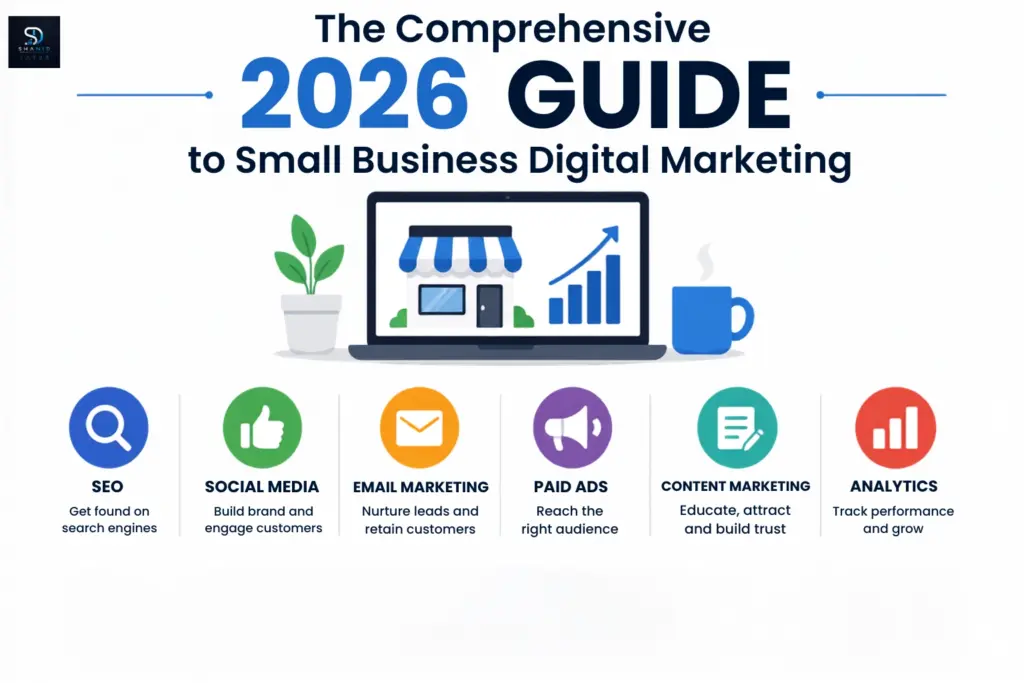
Running a small business today means competing in a marketplace that never sleeps. Your customers are scrolling Instagram at midnight, googling “best [your service] near me” on their lunch break, and comparing you against three other options before they even pick up the phone. If you’re not visible in those moments, you’re losing sales to a competitor who is — which is exactly why digital marketing for small business has become essential.
Digital marketing for small business has stopped being optional. It’s no longer a “nice to have” line item you get to when the budget allows — it’s the primary way most small businesses acquire new customers today. The good news? A Fortune 500 budget is not necessary to compete when you approach digital marketing for small business with the right priorities.
What matters more than budget size is having a clear strategy, consistent execution, and an understanding of which channels actually move the needle for a business your size when it comes to digital marketing for small business. Get those fundamentals right, and even a modest monthly spend can outperform a scattered, oversized one — which is the whole point of doing digital marketing for small business well from the start.
This guide breaks down everything you need to know to build a digital marketing plan that fits a small business budget, timeline, and team — without the fluff.
Why Digital Marketing Is More Important Than Ever for Small Businesses

Traditional advertising — billboards, print ads, local radio — still has a place, but it’s expensive, hard to measure, and iThe Core Channels of Digital Marketing for Small Businesses
mpossible to target precisely. Digital marketing flips that equation entirely.
With digital channels, you can:
Reach the exact people who are looking for what you sell, based on location, interests, search behavior, and demographics
Start on practically any budget and increase it as you achieve results.
Measure everything — clicks, conversions, cost per lead, and return on ad spend — in real time
Compete with bigger businesses on the strength of your content and customer experience rather than the size of your ad budget
Build long-term assets, like an email list or a ranking blog post, that keep generating leads long after you’ve stopped actively working on them
For a small business owner wearing ten hats already, that combination of affordability, precision, and measurability is what makes digital marketing worth prioritizing over channels that simply cost more and tell you less.
Building Your Small Business Digital Marketing Strategy

Before touching a single platform or tool, it helps to get the fundamentals in place. A strategy built on guesswork burns through budget fast; one built on a few clear decisions tends to compound.
1. Define Your Target Customer
You can’t market effectively to “everyone.” Get specific about who actually buys from you: their age range, location, income level, pain points, and where they spend time online. A local bakery’s ideal customer looks very different from a B2B software consultancy’s, and every channel decision downstream depends on getting this right first.
2. Set Measurable Goals
“Get more customers” is an unachievable ambition. “Generate 20 qualified leads per month through the website” is. Whether your priority is brand awareness, website traffic, lead generation, or direct sales, write the goal down with a number and a timeframe attached to it.
3. Know Your Budget and Prioritize Accordingly
Most small businesses can’t do everything at once, and trying to is often what causes marketing efforts to fizzle out. Pick two or three channels where your ideal customer already spends time, do them well, and expand from there once you see traction.
The Core Channels of Digital Marketing for Small Businesses

Search Engine Optimization (SEO)
SEO is the practice of improving your website so it ranks higher in search results for terms your customers are actually typing in. For small businesses, this is often the highest-leverage channel available because it captures people who are already actively looking for a solution.
Key areas to focus on:
- Local SEO: Claim and fully optimize your Google Business Profile, keep your name, address, and phone number consistent across directories, and collect genuine customer reviews. For any business with a physical location or service area, this alone can drive a significant share of new inquiries.
- On-page SEO: Make sure your website’s titles, headings, and content clearly reflect what you offer and the terms people search for.
Content SEO: Publishing helpful blog posts, guides, and FAQs around your customers’ questions builds authority and gives search engines more reasons to rank you.
SEO is a long game — expect three to six months before you see meaningful movement — but the traffic it generates is largely free once you’re ranking, which makes It’s among the best long-term investments a small business can make
Content Marketing
Content marketing is the engine behind most other digital channels. Blog posts, videos, guides, case studies, and email newsletters all serve the same purpose: demonstrating expertise and building trust before a prospect ever talks to you directly.
For small businesses, a simple and sustainable approach works best:
- Answer the questions your customers actually ask you, in writing or on video
- Repurpose one piece of content across multiple formats (a blog post becomes social captions, an email, and a short video script)
- Focus on consistency over volume — one solid post a week outperforms a burst of ten posts followed by three months of silence
Good content compounds. A well-written guide published today can keep attracting visitors, building trust, and generating leads for years.
Social Media Marketing
Social platforms let small businesses build a direct relationship with their audience without a media buyer or agency retainer. This is one of the most accessible entry points into digital marketing for small business, especially since the trick is choosing the right platform rather than trying to maintain a presence everywhere
- Instagram and TikTok work well for visually driven products, retail, food, and lifestyle brands
- Facebook remains strong for local businesses and community engagement, particularly with an older demographic
- LinkedIn is the natural home for B2B services, consultants, and professional services
- Pinterest can drive steady traffic for home, design, fashion, and DIY-related businesses
Whichever platform you choose, show up consistently, engage with comments and messages promptly, and resist the urge to only post promotional content — a good rule of thumb is that roughly 80% of your posts should inform, entertain, or help, with the remaining 20% focused on direct promotion.
Email Marketing
Email is frequently overlooked by small businesses chasing the latest platform trend, but it remains one of the highest-return channels available, largely because you own your list — no algorithm change can take it away from you.
Effective small business email marketing includes:
- A simple lead magnet (a discount, checklist, or guide) to grow your list
- A welcome sequence that introduces new subscribers to your business
- Regular value-driven newsletters, not just sales blasts
- Segmented campaigns based on customer behavior, like abandoned carts or past purchases
Even a modest list of a few hundred engaged subscribers can become a reliable, low-cost source of repeat business.
Pay-Per-Click (PPC) and Paid Social Advertising
Paid advertising gives you speed that organic channels can’t match. Google Ads captures people actively searching with buying intent, while paid social ads on Meta, TikTok, or LinkedIn let you get in front of your ideal audience even before they’re searching.
For small businesses starting out with paid ads:
- Start with a small daily budget and a tightly defined audience, then scale what performs
- Track cost per lead and return on ad spend, not just clicks or impressions
- Use retargeting to reach people who’ve already visited your site but haven’t converted — this is often the cheapest, highest-converting traffic you’ll get
Paid advertising works best layered on top of a solid website and clear offer; sending traffic to a weak landing page wastes budget no matter how well-targeted the ad is.
Website and Conversion Optimization
All the traffic in the world won’t help if your website doesn’t convert visitors into leads or customers. Your site should:
- Load quickly and work seamlessly on mobile devices, since the majority of local searches happen on a phone
- Make your offer and next step (call, book, buy) obvious within seconds of landing on the page
- Add clear calls to action throughout every page—not just the homepage
- Build trust through testimonials, reviews, and credentials
A modest investment in cleaning up your website’s clarity and speed often produces a bigger lift in leads than any single new marketing channel.
Bringing It All Together: A Simple Monthly Framework

A sustainable digital marketing routine for a small business doesn’t need to be complicated. A practical monthly rhythm could look like this:
- Publish one to two pieces of core content (blog post, video, or guide) tied to a topic your customers search for
- Repurpose that content into five to ten social posts and one email newsletter
- Monitor and respond to reviews and messages across Google, social platforms, and email
- Review performance data — website traffic, lead volume, and ad spend — and adjust what isn’t working
- Test one small paid campaign if budget allows, focused on your best-performing offer
The businesses that win at digital marketing rarely do the most; they do a manageable set of things consistently, then double down where the data shows results.
Common Mistakes Small Businesses Make
- Trying to be everywhere at once instead of mastering one or two channels first
- Chasing vanity metrics like follower counts instead of leads and revenue
- Inconsistent posting, followed by long gaps that erode audience trust
- No clear call to action, leaving visitors unsure what to do next
- Ignoring reviews and local SEO, which are often the fastest wins available for local businesses
- Giving up too early, particularly with SEO and content, before the compounding effects kick in
FAQ
- What is the appropriate amount of money for a small firm to invest in digital marketing?
Although there isn’t a set amount, a standard benchmark is 7–10% of revenue for well-established companies or a smaller fixed monthly expenditure (even $200–$500) for newly formed enterprises. The appropriate quantity depends more on the channels you’re focusing on than on a formula; PPC need a steady investment to produce data, but SEO and content require time rather than ad spend. - How long does it take to see results from digital marketing?It depends on the channel. Paid ads can generate leads within days. Social media engagement builds over weeks. SEO and content marketing typically take 3–6 months to show meaningful traction, since search engines need time to index and rank new or improved content. Businesses that expect SEO-level results in PPC timeframes usually end up disappointed and quit too early.
- Which digital marketing channel is best for small businesses to start with?There’s no single “best” channel for digital marketing for small business — it depends on where your customers already spend time. Local, service-based businesses often get the fastest wins from Google Business Profile optimization and local SEO. Product-based or visually driven businesses tend to see stronger early traction on Instagram or Pinterest. B2B companies usually do better starting with LinkedIn and email, but the right mix of digital marketing for small business channels always comes back to knowing your customer first..
- Can a small business do digital marketing without hiring an agency?Yes. Many small businesses run their own digital marketing for small business efforts — SEO, social media, and email marketing — successfully, especially in the early stages. The key is choosing two or three channels rather than trying to do everything, and being consistent. An agency or freelancer becomes more valuable for digital marketing for small business once you need to scale paid advertising or don’t have the bandwidth to stay consistent in-house.
- What’s the biggest mistake small businesses make with digital marketing?Spreading themselves too thin across every platform instead of doing a couple of channels well is one of the most common digital marketing for small business mistakes. A close second is inconsistency — posting heavily for a few weeks, then going quiet for months, which erodes both audience trust and any momentum built with search engines or algorithms, undermining the whole point of a digital marketing for small business strategy..
Final Thoughts
Digital marketing for small business isn’t about mastering every platform or outspending larger competitors — it’s about being genuinely useful and visible in the exact moments your customers are looking for a solution. Start with a clear understanding of who your customer is, pick two or three channels that match where they spend their time, and commit to showing up consistently.
The businesses that treat digital marketing for small business as an ongoing relationship with their customers, rather than a one-off campaign, are the ones that build lasting, compounding growth — one blog post, one email, one ad, and one satisfied customer at a time
visite for more blog