If you’ve spent any time researching digital marketing strategies, you’ve probably come across the term “meta marketing” and wondered what exactly it means. Is it marketing on Meta’s platforms like Facebook and Instagram? Is it a philosophical concept about marketing itself? The answer, interestingly, is a bit of both — and understanding the distinction can genuinely change how you think about your marketing strategy.
In this guide, we’ll break down what meta marketing really means, where the term comes from, how it applies to businesses today, and why it matters whether you’re a solo entrepreneur or running marketing for a growing brand.
What Is Meta Marketing? Understanding the Two Meanings

The confusion around “meta marketing” exists because the word “meta” carries two very different meanings depending on context.
1. Meta Marketing as a Conceptual Framework
In its original and academic sense, “meta marketing” refers to the study of marketing at a higher level — essentially, marketing about marketing. The prefix “meta” comes from Greek, meaning “beyond” or “about.” So meta marketing is the practice of stepping back from day-to-day campaigns and analyzing the broader systems, strategies, ethics, and societal impact of marketing as a discipline.
This concept has been discussed in marketing academia for decades, long before Facebook rebranded itself as Meta. It involves questions like:
- How does marketing influence consumer behavior on a societal level?
- What are the ethical boundaries of persuasion in advertising?
- How do marketing systems evolve across industries and cultures?
- What underlying principles connect seemingly unrelated marketing tactics?
Essentially, meta marketing in this sense is less about running a campaign and more about understanding the “why” behind marketing itself — the theory, psychology, and structure that shapes every strategy you’ll ever build.
2. Meta Marketing as Marketing on Meta Platforms
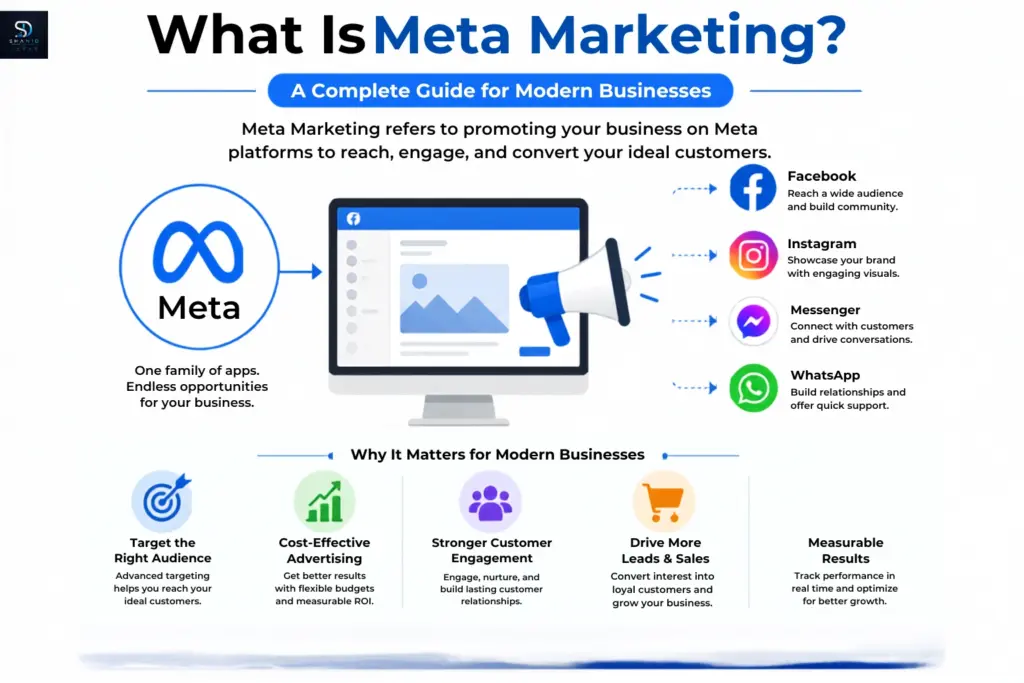
The second and far more common interpretation today is marketing conducted specifically through Meta’s suite of platforms — Facebook, Instagram, Messenger, and WhatsApp. Since Facebook rebranded to Meta in 2021, many marketers and business owners now use “meta marketing” as shorthand for advertising and organic content strategies executed across these interconnected platforms.
This is the definition most people searching for this term are actually looking for, so let’s dive deeper into what it involves.
What Does Meta Marketing Look Like in Practice?

When people talk about meta marketing in the platform sense, they’re usually referring to a combination of the following activities:
Meta Ads (Facebook & Instagram Advertising)
This is the backbone of meta marketing for most businesses. Meta Ads Manager allows advertisers to create highly targeted campaigns across Facebook and Instagram using a single dashboard. You can run:
- Awareness campaigns to build brand recognition
- Traffic campaigns to drive visitors to your website
- Engagement campaigns to boost likes, comments, and shares
- Lead generation campaigns to collect customer information directly within the platform
- Conversion campaigns to drive sales, sign-ups, or app installs
- Catalog sales campaigns for e-commerce businesses to showcase products dynamically
What makes Meta Ads particularly powerful is the platform’s audience targeting capabilities. Advertisers can target users based on demographics, interests, behaviors, custom audiences (like past website visitors), and lookalike audiences (people who resemble your existing customers).
Organic Content Strategy
Meta marketing isn’t only about paid ads. It also includes organic content published on Facebook Pages, Instagram profiles, Reels, Stories, and Messenger. This involves:
- Content calendars and posting schedules
- Community management and audience engagement
- Influencer collaborations
- Shoppable posts and Instagram Shopping integrations
- Building brand voice and storytelling across formats
Meta Business Suite and Analytics
Businesses use Meta Business Suite to manage both organic and paid content in one place, track performance metrics, respond to messages, and analyze audience insights. This centralized approach is a key part of what makes “meta marketing” distinct from marketing on other platforms — everything from ad creation to customer messaging happens within the same ecosystem.
WhatsApp Business Integration
For many businesses, especially in regions where WhatsApp is a dominant communication channel, meta marketing also includes WhatsApp Business tools — automated replies, catalogs, and click-to-WhatsApp ad campaigns that drive conversations directly from Facebook or Instagram ads.
Why Meta Marketing Matters for Businesses Today

Regardless of which definition you’re working with, there’s real value in understanding meta marketing — both the strategic mindset and the platform-specific execution.
1. Unmatched Audience Reach
Meta’s platforms collectively reach billions of active users worldwide. Facebook and Instagram remain among the most widely used social platforms globally, giving businesses of nearly any size access to a massive, diverse audience pool.
2. Precision Targeting
Few advertising platforms offer the level of granular targeting that Meta does. Businesses can layer demographic data, interests, purchase behavior, and custom audience lists to reach highly specific segments — reducing wasted ad spend and improving return on investment.
3. Cross-Platform Synergy
What Is Meta Marketing if not seamless cross-platform reach? Because Meta owns Facebook, Instagram, Messenger, and WhatsApp, marketers can build campaigns that flow effortlessly across platforms. This cross-platform flow is central to What Is Meta Marketing in practice — a customer might discover a brand through an Instagram Reel, engage with a retargeting ad on Facebook, and complete a purchase conversation through WhatsApp, all tracked within the same ecosystem. This is exactly why What Is Meta Marketing matters so much to modern brands: it turns separate touchpoints into one connected customer journey.
4. Data-Driven Decision Making
What Is Meta Marketing without data to back it up? Meta’s analytics tools provide deep insights into campaign performance, audience behavior, and content engagement. This is a core part of understanding What Is Meta Marketing, since it allows marketers to continuously test, learn, and optimize — a core principle of effective digital marketing. In the end, What Is Meta Marketing comes down to using these insights to make smarter, data-driven decisions.
5. Cost Flexibility
What Is Meta Marketing when it comes to budget? Meta Ads can work for virtually any budget. Small businesses can start with a few dollars a day, while larger brands can scale campaigns into six or seven figures. Understanding What Is Meta Marketing means recognizing this flexibility, which makes it accessible to startups and enterprises alike. Ultimately, What Is Meta Marketing comes down to using the right budget strategy for your business size and goals.
How the Conceptual Meaning Still Applies

Even if your primary interest is running ads on Facebook and Instagram, understanding What Is Meta Marketing in its original academic sense is worth keeping in mind. Thinking at a “meta level” about your marketing means regularly stepping back to ask:
- Is this campaign aligned with our broader brand values?
- Are we creating genuine value for our audience, or just chasing short-term metrics?
- How does this strategy fit into the larger picture of consumer trust and long-term brand equity?
Marketers who only focus on tactics — the next ad, the next post — often miss opportunities that come from strategic, big-picture thinking. So, What Is Meta Marketing really about? At its core, it’s about combining both meanings — the philosophical and the platform-based — since What Is Meta Marketing ultimately comes down to blending strategy with execution for stronger, more sustainable results.
Common Misconceptions About Meta Marketing

Misconception 1: What Is Meta Marketing? Many assume it’s only for large businesses. In reality, Meta’s advertising tools are designed to scale. Small businesses often see strong results with modest budgets, especially when targeting is well-defined.
Misconception 2: Understanding What Is Meta Marketing means realizing organic content still matters, even if you’re running ads. Organic presence builds trust and social proof. Users often check a brand’s profile before engaging with an ad, so a weak organic presence can undermine even well-targeted campaigns.
Misconception 3: What Is Meta Marketing, really? While related to social media marketing in general, meta marketing specifically refers to Meta’s ecosystem of platforms. Broader social media marketing might include LinkedIn, TikTok, Pinterest, X (formerly Twitter), and YouTube, each with different strategies and audience behaviors.
Getting Started With Meta Marketing

If you’re new to meta marketing in the platform sense, here’s a simplified path to get started:
- Set up Meta Business Suite and connect your Facebook Page and Instagram account.
- Define your target audience using demographic and interest-based data.
- Start with a clear objective — awareness, traffic, leads, or conversions — rather than trying to do everything at once.
- Create a small test campaign with a modest budget to gather performance data before scaling.
- Track key metrics like cost per click, conversion rate, and return on ad spend.
- Refine and optimize based on what the data tells you, rather than relying on assumptions.
- Layer in organic content to support and reinforce your paid campaigns.
Final Thoughts
What Is Meta Marketing? It sits at an interesting intersection of theory and practice. On one hand, it’s a conceptual lens for thinking critically about marketing as a discipline. On the other, it’s a very practical, results-driven approach to advertising and content strategy across Facebook, Instagram, Messenger, and WhatsApp.
For most businesses today, answering the question “What Is Meta Marketing” means learning how to use Meta’s advertising ecosystem effectively — targeting the right audience, crafting compelling content, and measuring what actually works. But keeping the bigger-picture, strategic mindset in view helps ensure that your campaigns aren’t just efficient, but genuinely aligned with your brand’s long-term goals.
Whether you’re just getting started or looking to refine an existing strategy, understanding What Is Meta Marketing offers one of the most powerful and flexible toolsets available in digital marketing today — as long as you approach it with both the tactical skills and the strategic thinking it deserves.
FAQ
- What does “meta marketing” actually mean?
It has two meanings: an academic concept referring to the study of marketing at a higher level — the theory, ethics, and societal impact of marketing as a discipline — and, more commonly today, marketing conducted specifically through Meta’s platforms (Facebook, Instagram, Messenger, and WhatsApp). - Is meta marketing the same as social media marketing in general?
No. Meta marketing specifically refers to Meta’s ecosystem of platforms. Broader social media marketing also includes platforms like LinkedIn, TikTok, Pinterest, X, and YouTube, each with its own strategies and audience behaviors. - Is meta marketing only suitable for large businesses with big budgets?
No. Meta’s advertising tools are built to scale, and small businesses can start with just a few dollars a day. Larger brands can scale into six or seven figures, making the platform accessible across business sizes. - Does organic content still matter if a business is running paid Meta ads?
Yes. Organic presence builds trust and social proof, and users often check a brand’s profile before engaging with an ad. A weak organic presence can undermine the performance of even well-targeted paid campaigns. - What’s the best way to get started with meta marketing on Facebook and Instagram?
Start by setting up Meta Business Suite and connecting your Facebook Page and Instagram account, define your target audience, pick one clear objective (awareness, traffic, leads, or conversions), and run a small test campaign to gather data before scaling and optimizing further.visit for more blog